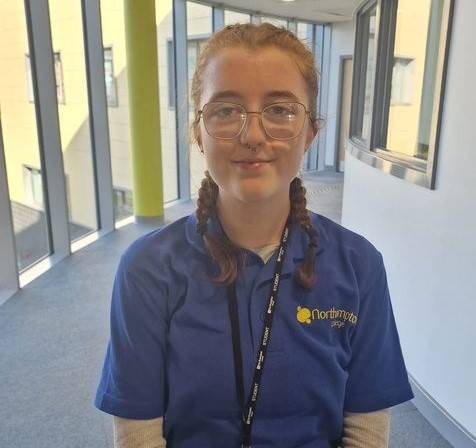
By Olga Melenciuc, Business student, 27 April 2026
On Earth Day, 22 April 2026, we took part in a sustainability competition where students were invited to explore environmental issues affecting their communities. The problem we chose to focus on was air pollution around schools and colleges in Northampton. Although it may seem like a local issue at first, we believe it reflects a much wider global challenge: how to protect people’s health while creating more sustainable and responsible communities.
Clean air is not something people should have to earn or fight for. It is one of the basic conditions of life. That is why air pollution is not just an environmental concern. It is also a health issue, an education issue and a social issue. When students are exposed to harmful emissions on their way to school, during drop-off times, and around the places where they learn, the environment around education is failing to support their wellbeing in the way it should.
What makes this issue especially important is that it affects young people at the exact times they are most exposed. The roads outside schools and colleges are often busiest at the beginning and end of the day, which means pollution peaks when students are arriving and leaving. For many people, traffic outside schools is seen as a normal part of daily life. However, normal does not always mean acceptable. If something puts health at risk, then it deserves much more attention than it often receives.
“Clean air is not just about the environment — it’s about our health and our future. If we don’t protect it now, we are affecting the way we live and exist.” — Olga
Our proposed solution focused on reducing traffic-related pollution around educational sites in Northampton in a realistic and practical way. We suggested restricted vehicle access close to school and college buildings, park-and-walk zones 300 to 500 metres away, and air quality monitoring before, during and after implementation. For us, it was important not just to suggest change, but to make sure that any change could be measured properly and introduced in a way that communities could understand and support.
This issue also connects Northampton to a much bigger global conversation. Cities such as London, Paris and Barcelona have already introduced similar approaches and shown that reducing pollution around schools is possible. That matters because it proves two things: first, that Northampton is not facing this problem alone, and second, that effective solutions already exist. In other words, this is not an impossible idea or an unrealistic ambition. It is a local response to a wider global challenge.
We also believe that environmental action is strongest when it is based not only on ideals, but on evidence and public understanding. During our work on this issue, we found that many people in the wider community were already aware of the problem and concerned about its effects. This is important because sustainable change does not happen through rules alone. It depends on people understanding why change is needed and feeling that they are part of the solution rather than being forced into it.
“Our goal was not just to create an idea, but to make it realistic. We wanted something that people would actually use and accept in their daily lives.” — Aleda
For us, this issue is also about responsibility. It is easy to think of environmental problems as something distant, something for governments, scientists or future generations to solve. But in reality, many of these challenges are already shaping everyday life. Young people are not separate from these issues. We are living with them now, and we will continue to live with their consequences in the future. That is why students should be encouraged not only to learn about environmental problems, but also to take part in discussing and solving them.
Our involvement in sustainability activities, including Planet Earth Games, has strengthened this belief. We have seen how important it is to raise awareness, start conversations and help people understand the real consequences of environmental damage. Many students care deeply, but they need more opportunities to engage with these issues in meaningful and practical ways. Awareness is the beginning, but action is what gives awareness value.
Cleaner air around schools matters more than people think because it is about much more than traffic. It is about health, fairness, responsibility and the kind of future we are creating. If we want to take environmental challenges seriously, we cannot focus only on distant global headlines. We also need to pay attention to the harmful conditions that already exist around us in everyday spaces. Real change begins when people recognise a problem, understand why it matters, and decide that ignoring it is no longer acceptable.